
Quick Answer: A terpene profile lists the aromatic compounds in a cannabis strain by concentration, typically expressed as a percentage of total weight. The dominant terpene (highest percentage) drives the primary effect and aroma. Secondary terpenes modify it. To read a profile: find the top three terpenes, look up their known effects, and use that combination to predict how the strain will feel before you grow or buy it.
For most of my early growing years, I ignored the terpene panel on strain descriptions completely. I chased THC percentage like everyone else, thinking a higher number meant a better grow and a better experience. Then I grew two strains back to back, both testing at 22% THC, and they produced completely different effects. One was clear-headed and energising. The other had me on the couch for three hours. The THC was identical. The terpene profiles were completely different.
Even two strains with the same THC percentage can feel completely different. One makes you energized and social; the other puts your mind into a calm, heavy drift toward sleep. The difference often is not the THC. It is the terpenes.
Once I understood that, everything about how I select strains, plan grows, and talk about cannabis to newer growers changed. Terpenes are not a bonus feature to explore after you have mastered everything else. They are the first thing worth understanding.
Disclosure: WeedMania420 participates in the Amazon Associates Program and the ILGM affiliate programme. Purchases through our links may earn us a small commission at no extra cost to you. We only recommend products we have genuinely researched and believe in.
Table of Contents
What Terpenes Actually Are
Terpenes are the aromatic oils produced by cannabis plants. These naturally occurring compounds are found in the trichomes of cannabis flowers and are responsible for each strain’s signature scent, taste, and effects.
They exist in virtually every plant on earth. The smell of lavender is linalool. The smell of black pepper is beta-caryophyllene. The smell of a pine forest is alpha-pinene. Cannabis produces over 200 different terpenes, though most strains express a handful of dominant ones in meaningful concentrations.
What makes terpenes particularly interesting in cannabis is that they do not just contribute to aroma. Terpenes do not get you high, but they may work with cannabinoids to shape your cannabis experience. A terpene profile, along with the cannabinoid content, can give users an idea of how the strain will interact with their body.
The mechanism behind this is known as the entourage effect. The entourage effect refers to the synergistic relationship between cannabinoids and terpenes. THC alone produces one type of experience. But combined with terpenes like myrcene, limonene, pinene, or linalool, THC’s effect becomes deeper, shaped, and more directional.
Think of THC as the volume dial and terpenes as the equaliser. Same volume, completely different sound depending on what the equaliser is doing.
Why Terpenes Matter More Than Sativa vs Indica
This is the biggest paradigm shift for most beginners. Modern research shows the indica and sativa model is botanically accurate but pharmacologically meaningless. The effects do not come from plant shape or leaf structure. They come from terpenes.
A myrcene-dominant strain may feel sedating whether it is labelled sativa or indica. A limonene-dominant strain may feel uplifting even if it is sold as an indica. Terpenes are the real effect predictors.
When you walk into a dispensary or browse a seed bank and see a strain labelled as a “relaxing indica” or an “energising sativa”, those labels are telling you about plant morphology, not effects. The terpene profile is telling you about effects. Learn to read the profile and you stop guessing.
This also has direct implications for home growers. If you are growing for a specific experience; sleep, creativity, pain relief, anxiety reduction, selecting a strain based on its terpene profile gives you a far more predictable outcome than selecting based on indica or sativa classification.
What a Terpene Profile Looks Like
A terpene profile is a list of individual terpenes and their concentrations, typically expressed as a percentage of total flower weight. Here is an example of what a real terpene panel looks like on a seed bank or dispensary product page:
Example: Blue Dream terpene profile
- Myrcene: 0.58%
- Caryophyllene: 0.18%
- Pinene: 0.14%
- Limonene: 0.11%
- Linalool: 0.06%
The numbers look small because they are. A terpene profile refers to the unique combination and concentration of terpenes found in a specific cannabis product or strain. These profiles help define aroma, flavour, and many of the sensory qualities of cannabis. Even at fractions of a percent, terpenes have a measurable influence on the experience.
Reading this profile, you immediately know this strain will smell and taste earthy and musky (myrcene), with a spicy warm undertone (caryophyllene) and a fresh pine edge (pinene). The effects will lean toward relaxation with a mild mood elevation from the limonene. Sedation is possible but not guaranteed given the mixed profile.
How to Read a Terpene Profile Step by Step
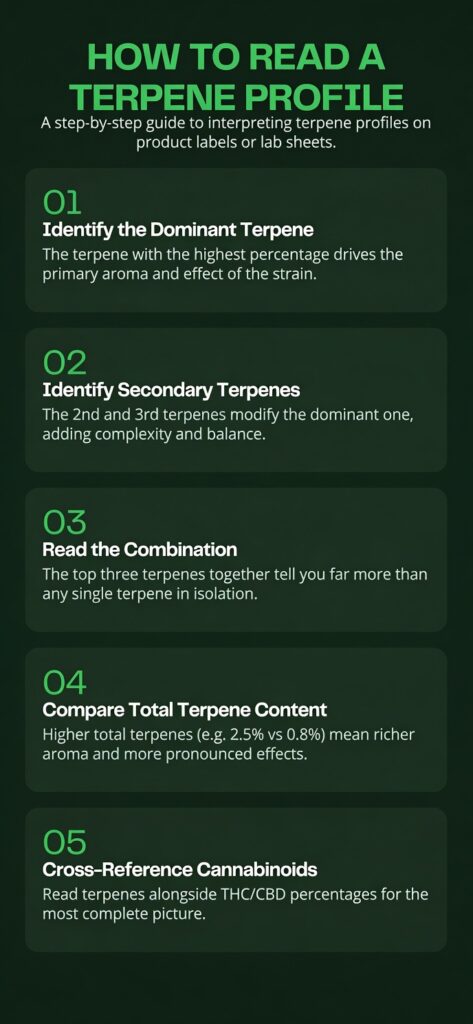
Here is a simple step-by-step to help you interpret a terpene profile on a product label or lab sheet: Look at the listed terpenes and note which terpenes are listed as dominant or present in higher percentages.
Step 1: Identify the Dominant Terpene
The terpene listed first or with the highest percentage is the dominant terpene. It drives the primary character of the strain, both in aroma and effect. In the Blue Dream example above, myrcene at 0.58% is dominant. The sedating, earthy, muscle-relaxing quality of myrcene will be the foundation of that experience.
Step 2: Identify the Secondary Terpenes
The second and third listed terpenes modify the dominant one. In the Blue Dream example, caryophyllene adds an anti-inflammatory and warming quality. Pinene adds mental clarity and potentially counteracts some of the sedation that high myrcene alone would produce. This myrcene-plus-pinene combination is part of why Blue Dream has a reputation for being relaxing without being fully couch-locking.
Step 3: Look for the Combination, Not Just Individual Terpenes
The combined reading of the top three terpenes tells you far more than any single terpene in isolation. A strain with both myrcene and limonene as dominant terpenes will behave differently from a strain with myrcene alone, because limonene’s mood-elevating properties actively counterbalance myrcene’s sedating tendency.
Step 4: Compare Total Terpene Content
Total terpene content matters as much as individual percentages. A strain with 2.5% total terpenes will produce a richer, more complex aroma and more pronounced effects than a strain with 0.8% total terpenes, even if the profile composition is similar. High total terpene content generally indicates better growing conditions, proper curing, and higher-quality genetics.
Step 5: Cross-Reference with Cannabinoid Ratios
A terpene profile read alongside the THC and CBD percentages gives you the most complete picture. High THC with high myrcene produces a very different experience from the same THC level with high limonene. High CBD with linalool is a classic calming combination. Read both panels together whenever they are available.
The Seven Terpenes Worth Knowing
You do not need to memorise all 200-plus cannabis terpenes. These seven appear most frequently in commercial strains and cover the vast majority of profiles you will encounter.
Myrcene
Scent: Earthy, musky, clove-like Primary effect: Sedating, muscle-relaxing, full-body calm Also found in: Mangoes, hops, thyme
Myrcene is often found in cannabis strains with a musky and earthy aroma, and may possess sedative properties, making it useful for relaxation and sleep. It is the most common terpene in cannabis and the one most associated with the stereotypical “stoned” body sensation. High myrcene is the defining characteristic of strains people describe as heavy or couch-locking.
Strains where it dominates: Granddaddy Purple, Blue Dream, Grape Ape, Cherry Pie OG. See our full terpene breakdown in the best weed strains for sex guide where myrcene plays a key role.
Limonene
Scent: Citrus, lemon, orange Primary effect: Mood-elevating, anxiety-reducing, energising Also found in: Lemon peel, oranges, juniper
Limonene is characterised by its citrus-like aroma and is known for potential mood-enhancing effects, offering relief from stress and anxiety. It boosts dopamine and serotonin activity, which is why limonene-dominant strains consistently feel uplifting regardless of their indica or sativa classification. Prioritise limonene when the goal is social energy or anxiety reduction.
Strains where it dominates: Sour Diesel, Wedding Cake, Super Lemon Haze, Strawberry Cough.
Beta-Caryophyllene
Scent: Spicy, peppery, woody Primary effect: Anti-inflammatory, pain-reducing, calming Also found in: Black pepper, cloves, cinnamon
Beta-caryophyllene is the one exception to the rule that terpenes do not produce intoxicating effects. It can bind to CB2 receptors, though this does not produce intoxication. Instead, CB2 activity is more often associated with processes such as inflammation and immune function.
This makes caryophyllene the most pharmacologically active non-cannabinoid compound in cannabis. It is the top terpene recommendation for anyone growing or using cannabis specifically for physical discomfort or inflammation.
Strains where it dominates: Girl Scout Cookies, Bubba Kush, OG Kush, Zkittlez.
Linalool
Scent: Floral, lavender, light and fresh Primary effect: Anxiolytic, muscle relaxant, sedating without heavy body load Also found in: Lavender, coriander, birch bark
With a floral scent reminiscent of lavender, linalool is often associated with relaxation and may help alleviate anxiety and stress. It is gentler than myrcene in its sedating quality, producing a calming, emotionally-settling effect without the same degree of physical heaviness. Linalool is the dominant terpene in strains recommended for anxiety management and is a key component of the best weed strains for sex terpene profiles we cover elsewhere on the site.
Strains where it dominates: Granddaddy Purple, Northern Lights, Do-Si-Dos, Amnesia Haze.
Alpha-Pinene
Scent: Fresh pine, forest air, woody Primary effect: Mental clarity, memory retention, alertness Also found in: Pine needles, rosemary, basil, dill
Pinene has a fresh pine aroma and is thought to aid memory retention and alertness while serving as an anti-inflammatory agent. It is one of the few terpenes that demonstrably counteracts some of the short-term memory impairment associated with high-THC consumption, which is why strains with both high THC and high pinene often feel clearer-headed than the THC percentage alone would suggest.
Strains where it dominates: Jack Herer, Blue Dream, Trainwreck, OG Kush.

Terpinolene
Scent: Fresh, floral, herby, slightly fruity Primary effect: Uplifting, creative, clear-headed Also found in: Apples, tea tree, lilac, nutmeg
Terpinolene is less common than the five above but produces a distinctly energising and creative mental quality when it is dominant. It is consistently described as producing a clear, focused high rather than sedation, regardless of the strain’s indica or sativa classification.
Strains where it dominates: Jack Herer, Ghost Train Haze, Durban Poison, Dutch Treat.
Humulene
Scent: Earthy, woody, hoppy Primary effect: Anti-inflammatory, appetite-suppressing Also found in: Hops, sage, ginseng, cloves
Humulene is the only cannabis terpene with a consistent appetite-suppressing effect, making it the notable exception in a plant otherwise associated with increased hunger. It frequently appears alongside caryophyllene in earthy, fuel-forward strains and contributes to the anti-inflammatory profile of those genetics.
Strains where it dominates: Girl Scout Cookies, White Widow, Headband, Sour Diesel.
A Practical Example: Reading Three Real Profiles
Here is how to apply everything above to three real strain profiles, using the kind of data available from any reputable seed bank or licensed dispensary.
OG Kush: Myrcene 0.44%, Limonene 0.26%, Caryophyllene 0.22%
Reading this: Myrcene leads, so expect a strong earthy aroma and significant body relaxation. Limonene as the secondary terpene lifts the mood component, preventing the experience from becoming purely sedating. Caryophyllene adds a physical anti-inflammatory layer. This is a balanced relaxation strain with mood elevation, suited to evening use where you want to be relaxed but not completely flattened.
Jack Herer: Terpinolene 0.52%, Caryophyllene 0.18%, Pinene 0.14%
Reading this: Terpinolene dominance means this strain will smell fruity and fresh and produce a clear, creative mental quality. Caryophyllene adds a warm spice note and physical calm without sedation. Pinene sharpens focus. The combined reading is an energising, creative strain suited to daytime use or any context where mental engagement matters. Zero couch-lock risk from this profile.
Northern Lights: Myrcene 0.61%, Linalool 0.22%, Caryophyllene 0.18%
Reading this: The highest myrcene percentage in these three examples tells you this will be the heaviest physical experience. Linalool as the secondary terpene adds emotional settling and anxiety reduction without the sharpness of limonene. Caryophyllene brings physical anti-inflammatory benefits. This profile is optimised for sleep and deep relaxation. Growing it in your 2×2 grow tent and managing it correctly through the late flower stage will produce exactly the heavy, calming effect this profile predicts.
How Terpenes Change During the Grow
As a grower rather than just a consumer, understanding that terpene expression is not fixed is important. The profile on a seed bank page represents optimal growing and curing conditions. Actual terpene content in your harvest will depend on several variables.
Temperature during late flower. High daytime temperatures above 80°F (27°C) volatilise and degrade monoterpenes like myrcene and limonene before harvest. Running your tent cooler in the final two weeks preserves terpene content. A VPD controller that maintains stable canopy-level temperature is one of the most practical tools for terpene preservation in a home grow.
Harvest timing. Harvesting at peak trichome maturity maximises both cannabinoid and terpene content simultaneously. Harvesting early reduces terpene expression significantly. A digital microscope or jeweller’s loupe to check trichome colour is the most important harvest timing tool available at any price point.
Curing. Slow curing at 60 to 65% RH in sealed glass jars for a minimum of three to four weeks allows terpene maturation and full flavour development. Rushing the cure by drying too quickly or in conditions above 70% RH degrades terpene content faster than almost any other post-harvest variable.
Nutrients. Overfeeding with nitrogen in late flower suppresses terpene production. Running lower nitrogen and higher phosphorus and potassium in the final three to four weeks of flower actively encourages terpene and resin development. See the autoflower nutrient guide for stage-by-stage feeding targets that support terpene expression.
Where to Find Terpene Profiles
Seed banks. Quality seed banks including ILGM, Seedsman, and Royal Queen Seeds publish terpene profiles alongside genetic descriptions. Not every strain listing includes full terpene data, but dominant terpenes are usually noted even when full percentages are not.
Licensed dispensaries. In legalised states and countries, licensed dispensaries display lab-tested terpene panels on product packaging or digital menus. This is the most accurate data available for purchased flower because it reflects the actual batch rather than genetic potential.
COA documents. A Certificate of Analysis (COA) from a licensed testing laboratory includes a full terpene breakdown alongside cannabinoid percentages. Ask for the COA whenever you buy from a licensed dispensary. If they cannot provide one, that is worth factoring into your purchasing decision.
Quick Reference: The Seven Terpenes at a Glance
| Terpene | Scent | Primary Effect | Common Strains |
| Myrcene | Earthy, musky | Sedating, relaxing | Blue Dream, GDP, Cherry Pie |
| Limonene | Citrus | Mood-lifting, energising | Sour Diesel, Wedding Cake |
| Caryophyllene | Spicy, peppery | Anti-inflammatory | GSC, OG Kush, Zkittlez |
| Linalool | Floral, lavender | Calming, anxiolytic | Northern Lights, Do-Si-Dos |
| Pinene | Pine, fresh | Focus, clarity | Jack Herer, Trainwreck |
| Terpinolene | Herby, fruity | Creative, uplifting | Jack Herer, Durban Poison |
| Humulene | Earthy, woody | Anti-inflammatory | GSC, White Widow |
FAQ
Do terpenes get you high? No. Terpenes are not what cause the intoxicating high from cannabis. They do not activate the brain’s CB1 receptors the way THC does. The one exception is beta-caryophyllene, which can bind to CB2 receptors, but it does not produce intoxication. They shape and modify the experience produced by cannabinoids rather than producing intoxication independently.
How do I know which terpene is dominant without a lab report? Smell. The dominant terpene in a strain is almost always the most prominent note in its aroma. A strong citrus scent means limonene dominance. A heavy earthy or musky smell means myrcene. A sharp pine note means pinene. Your nose is a surprisingly accurate terpene detector once you know what each major terpene smells like.
Do terpene profiles vary between batches of the same strain? Yes, significantly. Genetics set the potential terpene profile, but growing conditions, harvest timing, and curing determine how much of that potential is expressed. Two batches of the same strain from different growers can have meaningfully different terpene profiles and noticeably different effects.
Are terpenes destroyed by heat when smoking or vaping? Some. Sesquiterpenes like beta-caryophyllene and humulene are more heat-stable and survive vape, concentrate, and edible processing better, while monoterpenes like myrcene, limonene, pinene, and ocimene are more volatile and best preserved in low-temperature applications. This is why low-temperature vaping (below 180°C) generally produces a fuller terpene expression than high-temperature combustion.
Should I choose a strain based on terpenes or THC percentage? Terpenes. Understanding terpenes is the single biggest upgrade you can make in how you shop for cannabis. Whether you want better sleep, less anxiety, more focus, or a more enjoyable experience, terpenes are the key. THC tells you how potent the experience will be. Terpenes tell you what kind of experience it will be.